Food & Cafés
Seolleung Station Series
Sundae-guk in Seoul: A Korean Soul Food Guide Near Seolleung Station
Discover sundae-guk, Korea’s year-round soul food, at Nongmin Baekam Sundae near Seolleung Station — wait times, how to order, how to eat, and prices.
On a difficult day, is there a dish your mind turns to without effort? Perhaps it is the soup your mother made when you were a child, or the porridge you were served when you were unwell. Every culture has food that warms the heart. We call it soul food, or comfort food.
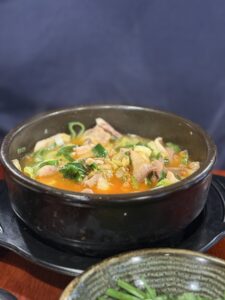
Korea has its own, and it has a distinctive quality: Korean soul food changes with the season, the weather, and even how one feels that day. Today I would like to introduce one of its finest representatives, gukbap, and in particular sundae-guk, a dish loved throughout the year that shines brightest in autumn and winter.
01
A Table That Follows the Seasons
Korea has four distinct seasons, and everyday life has grown around the idea that certain dishes belong to certain weather. In the heat of summer, Koreans restore their strength with nourishing dishes such as samgyetang, a ginseng chicken soup. On rainy days, they look for a hot broth or a savory pancake. When the first cold wind arrives, thoughts turn to steaming soups. There is a dish for the first signs of a cold, and another for the morning after a night of drinking.
Among all of these, the dish embraced most widely is gukbap.
02
What Is Gukbap?
Gukbap is often translated as “rice soup,” but the phrase falls short. It is closer to a complete meal in which hot broth, its generous ingredients, rice, and accompanying side dishes come together as one. When the bowl is empty, you feel full and quietly warmed through. “Hearty” and “heartwarming” are the words that suit it best.
03
The History Behind Gukbap
Gukbap traces back to the taverns and marketplaces of the Joseon era, where travelers and locals gathered at river crossings to eat quickly and cheaply. The dish’s earliest written recipe appears in the Gyugonyoram, a late-Joseon-era text, which describes rice topped with savory stewed meat. Under Japanese colonial rule, gukbap gained further popularity as one of Korea’s first common delivery foods — food that could be prepared in advance and served fast to a bustling marketplace crowd.
If you enjoy K-content, you have very likely met gukbap already. Korean historical dramas almost always include a scene of characters eating gukbap at a tavern or market. In modern dramas, a protagonist who has endured a hard day often finds his or her way to a gukbap restaurant. In Korean storytelling, gukbap is a symbol of comfort.
04
Types of Gukbap
Gukbap comes in many forms, depending on the broth and the ingredients.
Pork
Sundae-guk (Sundae-gukbap)
Pork bone broth with sundae, pork, and offal.
Pork
Dwaeji-gukbap
Centered on pork and pork bone broth, especially famous in Busan.
Beef
Seolleongtang
A milky broth made by simmering beef bones for hours.
Beef
Gomtang
A clear yet rich beef broth.
Beef
Sogogi-gukbap
Beef soup, either spicy or clear.
Vegetable
Kongnamul-gukbap
A refreshing soup with soybean sprouts.
05
Today’s Feature: Sundae-guk
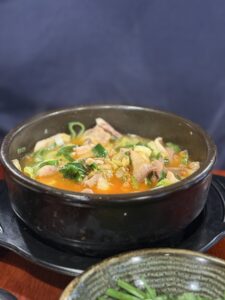
Sundae-guk is a gukbap made by simmering sundae, pork, and offal in a broth patiently extracted from pork bones. It is among the most popular lunch choices of Korean office workers, and few dishes are more familiar to the Korean table.
Why Is Sundae-guk Loved in Every Season?
Sundae-guk is popular all year. In cold weather, the hot broth warms the body. In hot weather, Koreans reach for hot soup all the same — there is a saying, iyeol-chiyeol, meaning to fight heat with heat. The idea is that eating something hot, and working up a sweat, helps you overcome the summer heat. That is why gukbap restaurants are full even in midsummer. Still, it is when the cool winds of autumn and the cold of winter arrive that a bowl of sundae-guk is most welcome.
06
What Is Sundae?
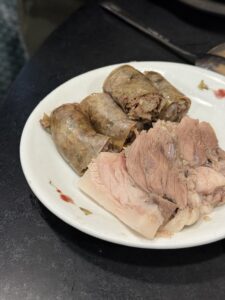
Sundae (pronounced soon-deh, and unrelated to the ice cream dessert) is a Korean sausage. Pig intestine is filled with glass noodles, vegetables, and sundae-style pork blood, then boiled or steamed. It is said to have developed from a food culture in which every part of the pig was used without waste when an animal was slaughtered for a feast or special occasion.
The name “Nongmin Baegam Sundae” comes from Baegam, a town in Yongin, Gyeonggi Province. Baegam takes its name from a large white rock (Baeg-am, literally “white rock”) near the village. The area became known for sundae through its traditional five-day market, Baekam-jang, where vendors began selling sundae and sundae-gukbap roughly six decades ago — a natural extension of the region’s long-standing hog-farming industry and its easy access to pork offal.
Sundae-guk restaurants prepare their sundae in different ways. Some buy ready-made sundae, while others make their own. The restaurants most admired for their sundae-guk tend to make it in-house, each with its own closely guarded method — the balance of fillings, the seasoning, and the way it is cooked all shape texture and flavor, so sundae is where a restaurant’s character shows most clearly.
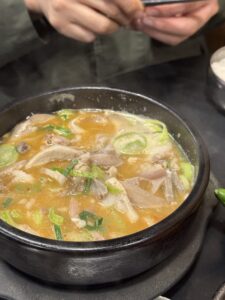
The foundation is a rich stock made by simmering pork bones for many hours. It is milky, nutty, and deep in flavor, and each restaurant differs in its supporting ingredients and method.
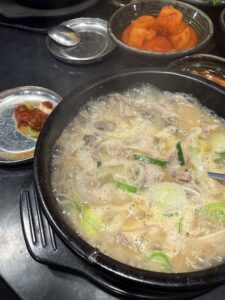
What’s in the bowl: sundae (sausage filled with glass noodles, vegetables, and pork blood), sliced pork (boiled pork cuts), and offal — the specific cuts vary from restaurant to restaurant.
07
Where to Go: Nongmin Baegam Sundae
Nongmin Baegam Sundae stands near Seolleung Station in Gangnam, Seoul. Its main branch and second branch face each other, and it is also a popular lunch destination for local office workers.
I would recommend visiting on a day off, with someone close to you, as a way of experiencing Korean food culture rather than in the middle of a demanding schedule. Sundae-guk has a strong aroma that can cling to clothing. If you have important meetings ahead, it is wise to enjoy a short walk in the fresh air after your meal, and schedule your appointments for afterward.
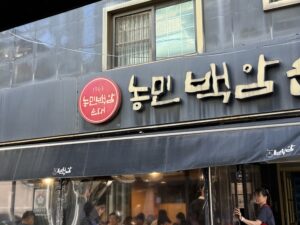
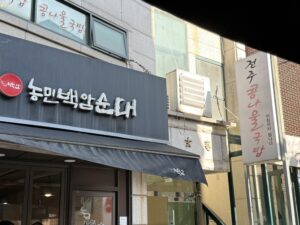
Nongmin Baegam Sundae — Seolleung Station Area
Gangnam-gu, Seoul. About a 10 to 15 minute walk from Seolleung Station, Exit 1. The street from Exit 1 is wide, which makes the restaurant easy to find.
Hours: Closed on Sundays. Other days, 11:10 a.m. to 9:00 p.m. Hours may change on Saturdays and public holidays, so check Google Maps before you go.
→ View on Google Maps
How Do You Wait for a Table at Nongmin Baegam Sundae?
There is almost always a line at both the main branch and the second branch, so if you can, avoid the lunch rush. Many Korean restaurants now use apps for remote waitlists, but this one is analog — there is a certain charm in experiencing Korean restaurant culture this way.
Write your initials and party size on the board outside the restaurant. Most guests write their name on the boards of both the main and second branches, so they can enter whichever has a table first. Wait nearby — a staff member will come out to the board and call your name.
Seating tip: the main branch has floor seating, where you sit on a wooden floor. If you would prefer a table and chairs, write your name only on the second branch’s board. Takeout requires no wait and is packed uncooked, so you can collect it without joining the line.
08
How to Order
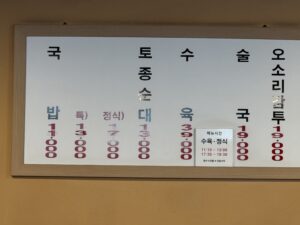
There are three main choices.
$7.9
Sundae-guk
The standard bowl (KRW 11,000). If it is your first visit, this is all you need.
$9.3
Teuk
A larger portion (KRW 13,000).
$12.1
Jung-sik (Set)
A set menu sold in limited quantities (KRW 17,000). Once it sells out, it is gone, so if it is available, it is worth trying.
Prices are converted at an approximate rate of 1 USD = 1,400 KRW and are estimates; the menu and prices may change over time.
09
How to Enjoy Sundae-guk
Everyone eats it a little differently, but here is a simple order I recommend for first-time visitors.
If you do not enjoy spicy food, scoop the red seasoning paste off the top of the soup and set it aside on the lid of your rice bowl. Begin with the ingredients, dipping them in the saeu-jeot (salted small shrimp) sauce. Next, enjoy the pork and the offal. Finally, add deulkkae-garu (perilla powder) and buchu (Korean chives), then stir in the rice and finish the meal as a warm gukbap.
10
Kimchi and Side Dishes: Self-Service and Free
In Korea, “self-service” means you help yourself to side dishes — there is a dedicated counter or container for them. Here, you will find a kimchi container where you may take as much as you like; refills on side dishes are usually free in Korea, and that is true here as well.
The kimchi is kkakdugi, a type of kimchi made from radish. Unlike napa cabbage kimchi, it is not spicy, so it is gentle even for first-time visitors. Its crisp texture pairs beautifully with the rich broth.
11
A Word of Caution: The Aroma
The aroma of sundae-guk may be unfamiliar. The sundae, the offal, and the pork bone broth each have a distinctive scent that can feel new at first, and it may also linger on your clothing and hair.
That said, many cultures have something similar. If you have enjoyed black pudding, think of sundae-guk as its Korean rice soup counterpart. Adding saeu-jeot, perilla powder, and chives softens the aroma considerably, so do try that combination. After your meal, I suggest a short walk in the fresh air, and scheduling any important appointments for afterward.
This is the bowl Koreans turn to when they are tired, when it is cold, and even when it is hot.
Enjoy sundae-guk on a day off with someone close to you, or as a moment of rest and cultural discovery during your time in Seoul. It is a chance to live out, for yourself, that scene you have seen in a K-drama.
Sources & Notes
Gukbap’s history — its roots in Joseon-era tavern and marketplace culture, its earliest written recipe in the Gyugonyoram, and its rise as a delivery food under Japanese colonial rule — is drawn from The UOS Times and Korea Traditional Medicine Food Research Institute reporting on Korean food history. The origin of the Baekam place name and its sundae tradition are drawn from the Gyeonggi Cultural Foundation’s regional archive and Yongin city administrative records. Prices are converted from Korean won to US dollars at an approximate rate of 1 USD = 1,400 KRW and are estimates, not exact conversions.
Paul Cho — Your Man in Korea
What is sundae-guk?
It is a Korean rice soup made by simmering sundae, pork, and offal in pork bone broth, served with rice. It is popular in every season and is one of the most common lunch choices among Korean office workers.
I am new to sundae-guk. How should I order?
Order the standard sundae-guk. If you would like a heartier portion, choose Teuk.
How much does sundae-guk cost at Nongmin Baekam Sundae?
The standard sundae-guk is KRW 11,000 (about $7.9), Teuk is KRW 13,000 (about $9.3), and the Jung-sik set is KRW 17,000 (about $12.1). These are estimates at 1 USD = 1,400 KRW.
What are the opening hours?
Closed on Sundays. On other days, it is open from 11:10 a.m. to 9:00 p.m. Hours may change on Saturdays and public holidays, so check Google Maps before visiting.
How does the waiting system work?
Write your initials and party size on the board outside. A staff member comes to the board and calls your name. It is an analog system rather than an app, and the wait is shorter if you avoid lunchtime.
Is takeout available?
Yes. Takeout is packed uncooked, and there is no wait.
I cannot eat spicy food. Is that a problem?
Not at all. You can remove the red seasoning paste, and the kimchi served is the mild kkakdugi.
Do side dishes cost extra?
No. The kimchi is self-service and free, so you may take as much as you like.
Can I sit at a table with chairs?
The main branch has floor seating. If you prefer a table and chairs, use the second branch.