Siloam (MARKERS WORSHIP) – Triads, Arrangement & Tone Guide
1. Song Information
- Song Title: Siloam (실로암)
- Artist: MARKERS WORSHIP (Lead Vocal: So Jin-young / Arranged by Lim Seon-ho)
- Key: G Major
- Tempo: 136 BPM (4/4 Time Signature, Driving Uptempo)
- Capo: No Capo
- Arrangement Difficulty: Advanced Beginner
2. Tone & Pedalboard Strategy
Maintaining clarity at 136 BPM requires dialing back excess reverb and keeping overdrive tight.
- Intro ~ Verse (Clean & Dynamic Rhythm):
- Pickups: Bridge/Middle position for crisp articulation.
- Tone Setting: Transparent Clean Tone with a light Compression and subtle Plate Reverb. Keep Delay off to preserve rhythmic sharpness.
- Pre-Chorus ~ Chorus (Building Dynamics):
- Tone Setting: Engagement of a tight Mid-gain Overdrive (e.g., TS-style pedal) to push the mid-range.
- Delay: Quarter-note or 8th-note Tap Delay with low feedback to fill space without muddying the rhythm.
- Break / Outro (Full Dynamics):
- Tone Setting: Stack a secondary boost or light overdrive for maximum sustain during rhythmic accents and chorus breaks.
3. Section-by-Section Arrangement & TAB Guide
📌 Intro (ITR) – Signature Riff (Original Copy)
- Recommended Position: Frets 2 to 8 (5th & 6th String Power Chords & Single Note Runs)
- Tone Setting: Heavy Mid-Gain Overdrive + Palm Mute on Single Note Runs
Here is the exact signature intro riff arrangement based on driving power chords and rhythmic bass lines:
Plaintext
🎸 How to Play the Riff:
[Part 1: G5 & 5th String Run]
e|-----------------------|
B|-----------------------|
G|-----------------------|
D|--5--------------------|
A|--5---5-3-2-0-2-3------|
E|--3--------------------|
   (G5) (A: 5->3->2->0->2->3)

[Part 2: 6th String Run & Eb/D]
e|-----------------------|
B|-----------------------|
G|-----------------------|
D|------------8---7------|
A|------------6---5------|
E|--3-2-1----------------|
  (E: 3->2->1)(Eb5)(D5)

[Part 3: Chromatic Run]
e|-----------------------|
B|-----------------------|
G|-----------------------|
D|-----------------------|
A|--5-6-7----------------|
E|----------7-6-5--------|
  (A:5-6-7)(E:7-6-5)

[Part 4: Resolving D5]
e|-----------------------|
B|-----------------------|
G|-----------------------|
D|--7--------------------|
A|--5--------------------|
E|-----------------------|
(D5)- G5 & 5th String Run: Hit the solid G5 (
E:3,A:5), then walk down and up on the 5th string (A: 5 - 3 - 2 - 0 - 2 - 3). - 6th String Run to Eb & D: Step down on the 6th string (
E: 3 - 2 - 1), then quickly punch the Eb 파워코드 (A:6,D:8) followed by the D 파워코드 (A:5,D:7). - Chromatic Run & D5 Resolution: Play the chromatic run up on the 5th string (
A: 5 - 6 - 7) and down on the 6th string (E: 7 - 6 - 5), then resolve cleanly onto the D 파워코드 (A:5,D:7) right before Verse 1!
📌 Verse 1 & 2 (V1 / V2)
- Recommended Position: Frets 3 to 7
- Voicing Approach: Use lightweight 2-note guide-tone voicings to keep the rhythm bouncy without overpowering the vocal line.
Plaintext
  G (Fret 3-5)         Em7 (Fret 5-7)      Am7 (Fret 5)
e|-------------------|-------------------|-------------------|
B|--3----------------|--8----------------|--5----------------|
G|--4----------------|--7----------------|--5----------------|
D|--5----------------|--9----------------|--5----------------|
A|-------------------|-------------------|-------------------|
E|-------------------|-------------------|-------------------|
- Playing Tips: Keep your strumming hand relaxed. Strum cleanly on beats 1 and 3, using light staccato muting on off-beats.
📌 Pre-Chorus (Passing Chords)
- Recommended Position: Frets 5 to 10
- Chord Walk:
G➔G7/B➔C➔Am7➔Bm7➔Em7➔Eb9(#11)➔C/D
Plaintext
  Eb9(#11) Option      C/D (D7sus4)
e|-------------------|-------------------|
B|--6----------------|--5----------------|
G|--6----------------|--5----------------|
D|--5----------------|--0 (or Mute)------|
A|--6----------------|-------------------|
E|-------------------|-------------------|
- Playing Tips: The
Eb9(#11)acts as a chromatic passing chord leading intoC/D. If the grip feels tricky, hold a simple 3-note chromatic shape on strings 2, 3, and 4 on fret 6.
📌 Chorus (C, C1, C2)
- Recommended Position: Frets 7 to 10
- Core Triad Loop:
G–G7/B–Cmaj7–Fmaj9–Em7–A7–D(sus4)
Plaintext
G Triad      G7/B Guide   Cmaj7        Fmaj9
e|-----------|------------|------------|------------|
B|--8--------|--6---------|--5---------|--8---------|
G|--7--------|--7---------|--5---------|--9---------|
D|--9--------|--9---------|--5---------|--7---------|
A|-----------|------------|------------|------------|
E|-----------|------------|------------|------------|- Playing Tips: Open up your strumming stroke during the Chorus. Ensure the transition from
Cmaj7toFmaj9stays smooth by sliding your middle finger smoothly along string 3.
4. Creative Fill-in & Rhythmic Accent Ideas
During vocal pauses in the Chorus (after “Siloam, given to me”), try adding these simple 2-note scale fills:
Plaintext
Fill Idea 1 (G Major Scale Sliding Hook)
e|-------------------|
B|--8/10--8--7-------|
G|--------------9----|
D|-------------------|
A|-------------------|
E|-------------------|

Fill Idea 2 (Double Stop Accent)
e|--7/8---7----------|
B|--8/10--8----------|
G|-------------------|
D|-------------------|
A|-------------------|
E|-------------------|
5. G Major Scale Position (Frets 0 ~ 12 Map)
To navigate fills and construct triad shapes confidently across the neck, study the G Major Scale positions:
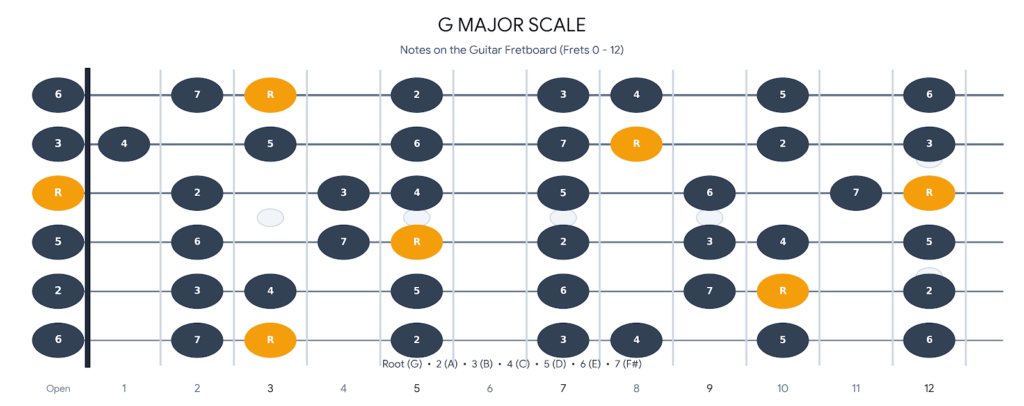
- Scale Notes: G – A – B – C – D – E – F#
- Degree Formula: Root (1) – 2 – 3 – 4 – 5 – 6 – 7
💡 Application Tip: Locate the Yellow Root Notes (R) on string 6 (fret 3), string 4 (fret 5), string 3 (open/fret 12), and string 2 (fret 8). Connect these root anchors directly to your 2-3-4 string triads!
6. Guitar Vocabulary for Worship Guitarists
- Guide Tones: The 3rd and 7th scale degrees of a chord. Playing just these two notes yields a full harmonic sound without cluttering fast tempo transitions.
- Syncopation: Accenting the off-beats (the “and” of the beat). Crucial for capturing the driving, joyful groove of MARKERS WORSHIP’s arrangement.
- Passing Chord: A transitional chord placed between two main structural chords (like
Eb9(#11)betweenEm7andC/D) to create subtle chromatic tension.
7. Musician’s Note & Practice Routine
🎸 Musician’s Note
When I first tried playing this arrangement at 136 BPM, my left hand tensed up trying to play full barre chords. The moment I switched to 3-string triads around frets 7–9, my hands felt completely relaxed, and the rhythmic driving feel instantly locked into the drum groove. As a worship guitarist practicing here in Korea, sharing these small practical tweaks with praise teams around the world is a real joy!
📅 Recommended Weekly Practice Routine
- Day 1–2 (Muting & Triad Shapes): Practice switching between the
G,G7/B,Cmaj7, andFmaj9triads at 100 BPM with clean palm muting. - Day 3–4 (Passing Chords & Transitions): Isolate the Pre-Chorus section (
Em7➔Eb9(#11)➔C/D) and practice clean chord changes. - Day 5–6 (Full Speed Run): Play along with the MARKERS WORSHIP track at the full 136 BPM, focusing on light hand tension and dynamic control.
Closing Thoughts
Playing fast uptempo songs like “Siloam” isn’t about playing more notes—it’s about playing the right voicings efficiently. As a fellow beginner practicing electric guitar in Korea, I really wanted to introduce this iconic Korean worship arrangement and its practical guitar approach to worship teams everywhere. Keep practicing, and blessings on your upcoming worship service rehearsal!