FOOD & CAFÉS
Seoul Travel Guide · Spring Edition
Seoul in Spring — Cherry Blossom, Seokchon Lake, and Coffee
The shortest, most beautiful season in a city that comes fully alive — where to see it, when to go, and where to have coffee after.
Korea is one of the few countries in the world where the four seasons still arrive with genuine conviction. Spring, summer, autumn, winter — each carries its own distinct character. While climate change has blurred seasonal boundaries across much of the world, Korea’s four seasons remain remarkably defined. Winter is genuinely cold. Summer is genuinely hot. And in between, spring and autumn arrive briefly but beautifully. Of the four, spring is the most anticipated. It has an unofficial nickname: the season of flowers.
Seoul’s spring temperatures break down like this. In March, mornings and evenings can drop to 5–8°C, while afternoons warm to around 13°C. By April, daytime highs reach 18°C and the city settles into full spring mode. May brings 15–23°C warmth, though the midday sun is already noticeably strong. All three months share one critical trait: large daily temperature swings. April in particular has the widest temperature range of any month in Seoul. It is entirely normal to leave the hotel in a padded jacket and want a t-shirt by lunch.
One more thing to watch: air quality. Spring brings yellow dust blowing in from mainland China, alongside tree pollen. High particulate days are common throughout March and April. Download a weather app before you arrive — Naver Weather or KakaoMap both show real-time air quality. Plan outdoor activities around clear days. This is basic preparation for any Seoul spring trip.
01
Why Seoul, Why Spring
Seoul is an unusual city. It is a dense metropolis and yet it has mountains — Bukhansan and Dobongsan form a northern wall visible from almost anywhere in the city. The Han River cuts a wide path through the middle. And between those two features lies one of the most varied urban landscapes in Asia: mountain trails, riverside parks, dense commercial districts, and quiet alleyways all within the same city limits.
Spring is the season when all of it wakes up at once. Flowers appear on the mountain slopes. The river banks turn pink. Café terraces open. The light gets longer. It is the moment Seoul looks exactly like the version of itself it most wants to be.
The weather also happens to be ideal for travel. Not heavy, not humid, not yet hot. The kind of temperature where you can walk for hours without thinking about it. For first-time visitors and returning ones alike, spring shows Seoul at its most generous.
02
Spring Flowers & When They Bloom
Seoul’s spring doesn’t arrive all at once. The flowers take turns — a relay of bloom running from late February through early May. Knowing the sequence helps you plan around what you most want to see.
Late Feb – early Mar · The first sign of spring
Early – mid Mar · Small yellow clusters
Mid – late Mar · Large white flowers, brief and dramatic
Late Mar – early Apr · Bright yellow, visible everywhere in Seoul
Late Mar – early Apr · Pink hillsides across the city
Early – mid Apr · Seoul peak typically April 7–10
Late Apr – early May · The closing act of spring
Late Apr – early May · You’ll smell it before you see it
Of everything on this list, the strongest recommendation is cherry blossom. The scale, the atmosphere, and the way it transforms the city is unmatched. Seoul’s average peak bloom falls around April 7–10 — but this shifts by several days depending on the year’s temperatures. Always check the bloom forecast before finalising your travel dates.
03
The Cherry Blossom — Origins
The wild ancestors of the cherry blossom originate near the Himalayan foothills. Cherry trees grew across temperate Asia for centuries. But the ornamental trees lining city streets today — dense with petals, bred for beauty — are not wild species. They are carefully developed cultivars refined over hundreds of years.
There is a long-running debate about origins. Korean researchers have argued for decades that the ancestor of the most common variety, the Somei-yoshino, is native to Jeju Island. A French missionary, Father Émile Taquet, found a self-growing king cherry on the slopes of Mt. Halla in 1908 at 600 metres elevation. In 2018, the National Arboretum of Korea completed a full genome analysis and concluded that Jeju’s cherry and Japan’s Somei-yoshino are two distinct species — both self-developed in their own regions. The origin debate settled, but the existence of a Jeju native cherry remains undisputed.
The culture of cherry blossom viewing — gathering beneath blooming trees in spring — was formalised in Japan as hanami. The earliest recorded hanami took place in 812 CE. Japan’s role in spreading cherry blossom culture globally is significant: in 1912, Japan gifted over 3,000 cherry trees to Washington D.C., giving birth to the Tidal Basin festival that continues today.
04
Korea & Japan — Two Ways to See Cherry Blossoms
Japan comes to mind first for most people when cherry blossoms are mentioned — and with good reason. In Japan, cherry blossom is more than a flower. It is woven into national identity: police and military insignia, centuries of haiku and woodblock art. In Japanese culture, cherry blossom carries the weight of mono no aware — the bittersweet awareness of impermanence, the beauty of things precisely because they do not last.
Korea’s relationship with the flower is different, and more complicated. During the Japanese colonial period (1910–1945), cherry trees were planted across Korea by Japanese residents. After liberation, many were cut down as symbols of occupation. The mood shifted when researchers confirmed the Jeju king cherry as a distinct Korean native. Today, cherry blossom in Korea carries no philosophical weight — it is the flower of spring, associated with warmth, family, festivals, and the first real outdoor day of the year.
Tokyo: late March · Seoul: early to mid April · Roughly two weeks apart due to climate
Both countries primarily plant Somei-yoshino. Korea is gradually expanding Jeju king cherry planting
Japan — impermanence, artistic symbolism. Korea — spring celebration, family outings, seasonal festivals
1912: Japan gifted 3,000+ trees to the U.S. During WWII the trees nearly faced removal — Korean independence activists including Syngman Rhee are said to have intervened by arguing the trees were of Korean origin
05
Cherry Blossom Spots in Korea
Korea has over 200 cherry blossom festivals and viewing spots nationwide. These are the ones worth knowing.
Korea’s largest cherry blossom festival. The entire district of Jinhae turns pink for 10 days in early April. The naval base and warships provide a backdrop found nowhere else. Crowds are enormous — plan well in advance.
The most famous cherry blossom road in Seoul. Over 1,600 trees along the Han River embankment form a continuous pink tunnel. During the Spring Flower Festival the area is extremely crowded — weekday mornings are significantly calmer.
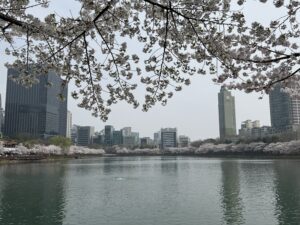
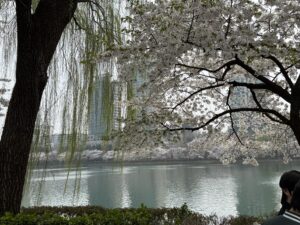
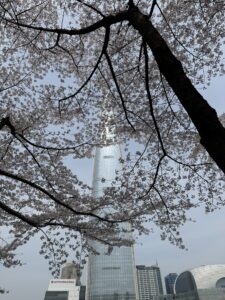
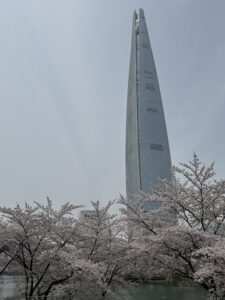
2.5 km of cherry-lined lake path with Lotte Tower as the backdrop. One of Seoul’s most photogenic spring locations. Family-friendly, flat, and easily accessible by subway. Detailed below.
The ancient Silla capital surrounded by cherry blossoms. Bomun Lake, the city centre, and the Bulguksa Temple grounds all bloom together. The historical setting gives this a completely different mood from Seoul.
A quieter riverside path through southern Seoul. Significantly less crowded than Yeouido or Seokchon. A local favourite for those who want atmosphere without festival-level crowds.
A 4.3 km cherry blossom path along a coastal lake. The view combines ocean, lake and blossoms in one frame. Blooms 2–3 days later than Seoul — good for extending the season if you’re heading east.
06
Seokchon Lake & Jamsil — For Families
If you’re travelling with children, or simply want one area where you can spend an entire day without needing to move far, Jamsil is the answer. No single district in Seoul concentrates this much into a walkable area.
Seokchon Lake is divided into two sections.
The side facing Lotte Tower and Lotte Mall. The view of Lotte Tower reflected across the lake with cherry blossoms in the foreground is one of the defining spring images of Seoul. Access: Jamsil Station, Line 2, Exit 2.
The side facing Lotte Department Store, Lotte World, and Lotte Hotel. More activity-centred, with the theme park directly adjacent. Access: Jamsil Station, Line 2, Exit 3.
The two lakes are connected. Walking the full 2.5 km perimeter takes you naturally from East to West and back. There is no barrier between the two sides — the path simply continues around the full loop. You can start at either exit and end up at the other.
Theme park directly adjacent to the West Lake. Indoor and outdoor facilities mean it works in almost any weather. The natural anchor for a full family day in Jamsil.
Seoul’s tallest building at 123 floors. The observation deck on clear spring days offers views of the Han River, the mountains, and the city in every direction.
The café and restaurant street surrounding Seokchon Lake. Well-established dining options ranging from Korean set meals to brunch cafés. Several spots have lake-facing terraces that are particularly good in spring.
15 minutes on foot. Wide lawns, 1988 Olympic monuments, and enough open space for children to run freely. A good second stop after the lake walk.
Jamsil Station, Line 2. Accessible from virtually anywhere in Seoul. On cherry blossom weekends, arrive before 10am or after 6pm to avoid peak crowds.
Seoul’s spring is brief. That is exactly what makes it worth planning for.
07
Where to Have Coffee — Wicker Park
After the lake walk, there is one café worth singling out: Wicker Park. A specialty coffee shop on the café street surrounding Seokchon Lake — quiet, well-made, and not a chain. The kind of place locals return to regularly rather than discover once.
There are two locations, and they are meaningfully different from each other.
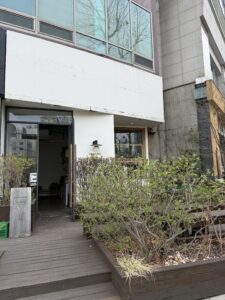
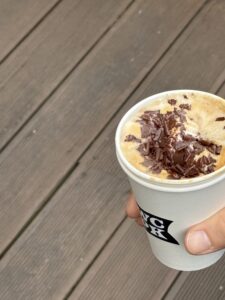
Coffee-focused. This is where you come for espresso-based drinks. The signature order is the warm cappuccino with a slice of chocolate laid across the top — a small detail that makes a real difference in both texture and flavour. The chocolate cappuccino is available at this location only.
Brunch-focused. Floor-to-ceiling windows, abundant plants, spacious layout. The menu leans toward food — sandwiches, salads, the Big Breakfast. The coffee menu is also different. The chocolate cappuccino is not available here.
Must order: warm cappuccino with sliced chocolate, East location only. The chocolate is laid across the top of the cup and softens gradually into the foam. Simple concept, executed well.
Finding it: the entrance can be easy to walk past. The East location sits on a street corner — look for it at the intersection, not mid-block.
298 Seokchonhosu-ro, Songpa-gu, Seoul (Jamsil Daewoo Lake World)
Mon–Sun 10:00–22:00 (standard hours). Hours may change during cherry blossom season — always confirm before visiting.
08
Timing Is Everything — And Luck Helps
Cherry blossoms have conditions. The weather has to cooperate. The timing has to align with your travel dates. And the two have to agree with each other.
From first bloom to full peak takes about 5–7 days. The window of full bloom lasts only 3–5 days. Rain shortens it. Wind can end it in a morning. A cold snap in early April pushes the whole sequence back by a week. The Korea Meteorological Administration publishes official bloom forecasts starting in late February — worth tracking before you finalise any plans.
Which means cherry blossom travel requires a small amount of luck. Plan carefully, check the forecasts, but hold the schedule loosely. A day of half-bloom is still a beautiful day. Petals falling in the wind is its own kind of scene. Seoul in spring does not need to be perfect to be worth it.
Seoul’s spring is brief. That is exactly what makes it worth planning for.
Mountains behind, a river through the middle, and a city that knows how to come alive in the space between. Cherry blossoms above Lotte Tower. A warm cappuccino with chocolate at a corner café. A child walking along a lakeside path lined with pink. Travel is the accumulation of scenes like these — and Seoul in spring provides them generously.
Thank you for reading. Hope to see you in Seoul this spring.
Sources & References
All factual content in this guide has been compiled from the publicly available sources listed below. Bloom timing data reflects 2026 forecasts and historical averages. Café information is accurate as of April 2026.
Official spring bloom forecasts, temperature averages, and seasonal climate data for Seoul.
2026 cherry blossom bloom forecast — national average peak date April 7. Primary source for bloom timing data throughout this guide.
Monthly temperature ranges for Seoul, March–May.
2018 genome analysis establishing Jeju king cherry and Japanese Somei-yoshino as genetically distinct species.
Historical documentation of the Jinhae cherry blossom story, including post-liberation removal and replanting.
Café information, location details, and menu overview.
Reference for Seokchon Lake area overview, Songridan-gil context, and Wicker Park West brunch menu.
This guide is original editorial content written for an international travel audience. Bloom timing is based on 2026 forecasts and long-term averages — actual dates vary year to year, always verify with KMA or Naver Weather before travel. Café hours and menus are accurate as of April 2026; confirm current hours directly with the venue, especially during cherry blossom season.