When serving with the electric guitar in church, one of the biggest challenges is how to support the worship session musically and richly without overpowering the team.
Today, we will look at “Steadfast Love of the Lord” (한결같은 주의 사랑이) by F.I.A WORSHIP. This medium-tempo, contemplative song is excellent for beginner electric guitarists to practice song dynamics, learn efficient triad shapes, and understand basic scale application on the fretboard.
1. Song Information
- Song Title: Steadfast Love of the Lord (한결같은 주의 사랑이)
- Artist: F.I.A WORSHIP (Lyrics/Composed by Lee Dong-sun / Arranged by Park Yu-bin)
- Key: G Major
- Tempo: 85 BPM (4/4 Time Signature)
2. Song Analysis & Tone Strategy
This song begins as a quiet, personal confession and gradually deepens into the chorus. The electric guitar should build tone layer by layer to match the emotional flow of the song.
📌 Intro ~ Verse (Beginning)
- Tone Setting: Use a Clean tone with generous Delay and Reverb to create an ambient, pad-like texture.
- Playing Style: Avoid heavy rhythmic strumming. Focus on holding long notes or softly filling the empty spaces between the vocal melodies.
📌 Chorus (Peak & Build-up)
- Tone Setting: Engage a Mild Overdrive to add warmth, body, and sustain to your tone.
- Playing Style: Lock into the rhythm, but instead of full strumming like an acoustic guitar, use triad shapes centered on strings 2, 3, and 4 to provide clear, clean harmony.
3. Key Triad Chords (Focus on Strings 2, 3, and 4)
Beginners often make fingering mistakes or lose the rhythm when shifting hand positions across the neck. The TABs below are positioned around frets 7 to 10 (strings 2, 3, and 4) to minimize hand movement and allow smooth chord transitions throughout the entire song.
① G
e|---------
B|--8------ (G)
G|--7------ (D)
D|--9------ (B)
A|---------
E|---------
② F#m7(b5)
e|---------
B|--10----- (A)
G|--9------ (E)
D|--10----- (C)
A|---------
E|---------
③ B7
e|---------
B|--10----- (A)
G|--8------ (D#)
D|--9------ (B)
A|---------
E|---------
④ Em7
e|---------
B|--8------ (G)
G|--9------ (E)
D|--9------ (B)
A|---------
E|---------
⑤ Ebm7 (Passing Chord)
(Passing chord from Em7 to G/D: Simply shift the same shape down 1 fret)
e|---------
B|--7------ (F#)
G|--8------ (Eb)
D|--8------ (Bb)
A|---------
E|---------
⑥ G/D
e|---------
B|--8------ (G)
G|--7------ (D)
D|--9------ (B)
A|---------
E|---------
⑦ C
e|---------
B|--8------ (G)
G|--9------ (E)
D|--10----- (C)
A|---------
E|---------
⑧ G/B
e|---------
B|--8------ (G)
G|--7------ (D)
D|--9------ (B)
A|---------
E|---------
⑨ Am7
e|---------
B|--8------ (G)
G|--9------ (E)
D|--7------ (A)
A|---------
E|---------
⑩ C/D
(Maintains the C triad shape, blending with the D bass note)
e|---------
B|--8------ (G)
G|--9------ (E)
D|--0------ (D)
A|---------
E|---------
4. Practical Playing & Melody Tips
- Minimize Hand Movement: Notice how all these chords live within frets 7 to 10. Only 1 or 2 fingers change positions while keeping your hand fixed in one region.
- Leave Room for the Bass: Avoid low notes on strings 5 and 6 to give space to the bass guitar. Electric guitar sounds cleanest in the worship mix when holding down middle-register harmonies on strings 2, 3, and 4.
- Melodic Transitions: During vocal pauses (e.g., after the phrase “overwhelming life”), softly layer a C → C/D → G melodic transition with delay trails to elevate the song’s overall polish.
5. G Major Scale Position (Frets 0 ~ 12 Map)
To fill vocal pauses, play subtle lead lines, or create smooth transitions in G Major, practice navigating the full G Major Scale across the fretboard.
- Scale Notes: G – A – B – C – D – E – F#
- Degree Formula: Root (1) – 2 – 3 – 4 – 5 – 6 – 7
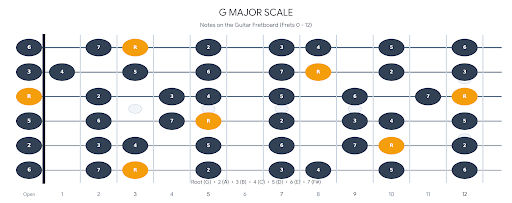
💡 Application Tip:
Focus on locating the Yellow Root Notes (R) on string 6 (fret 3), string 4 (fret 5), string 3 (open/fret 12), and string 2 (fret 8). Connecting these anchor roots to your 2-3-4 string G Major triads will make your worship fills feel natural, expressive, and connected!
Closing Thoughts Rather than playing too many notes, the key to electric guitar in worship is backing up the ensemble with precise positioning and clean tone. Try learning these triads and scale shapes on frets 7–10, and gently apply them to your worship team’s setlist this week.